





Competing for Spray Foam Bids: Smart Bidding Advice

Which of the photos above is representative of your company?
In a marketplace where perhaps a dozen spray foam contractors are competing for the same residential insulation jobs, is it possible to get profitable jobs from the chronic low bid contractors?
Over the last 50 years that I have been in the spray foam insulation business, I have found that companies that have great quality and good reputations can thrive even in a highly competitive marketplace.
The following are a few tips to make your company stand out from the others:
Step 1: Perform a Market Research:
Its hard to find out why and how other contractor are bidding so low without decent information on the marketplace. Find out why or how the other contractor(s) are bidding so low. It is possible for a small contractor with a very low overhead to apply foam cheaper than a larger contractor and still make a reasonable profit.
Determine the overall size of the insulation market. What industries use your type of services? What is their relative financial status? You may find that the economy is not robust enough for good profits? How many competitors are there and what is their market share? Are they making money or just barely hanging on. What are their strengths and weaknesses?
But, more often a chronic low bidder is taking some short cuts to get the price down. Check out whether they have insurance and how much. Do they spray less foam than the specification calls for? Are they just working for wages and not saving money for overhead, equipment maintenance? Do they cut corners on safety and health practices?
Perform a self-analysis on your company’s work and quality. What are your strengths and weaknesses? See how you match up against your low-bid competitor. If you have much better quality and provide more professional services, then you can point out those differences to a prospective client.
Build a Reputation for Better Quality and Service

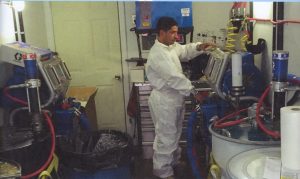
Keep a neat, clean rig with professional looking employees. (L) cluttered, messy Rig (R) Clean
Most folks will buy a higher priced product or service if they perceive a better quality and value in the product. For example, you would expect to pay a significantly higher price for a new Mercedes sports car over a Hugo. A savvy customer will know that too low a price can result in a poor application.
There are customers who are always looking for a deal and the lowest price. A contractor can go out of business catering to that cliental. Establish your company’s focus away from the low-bid client towards one that wants the best quality and is willing to pay a premium for the service.
Sprayfoam is already considered a premium product in the prospective customers mind so half of your work is already done. A typical spray foam job is more than double what a fiberglass insulation job would cost. So, a prospective customer is likely to buy up rather than down.
There are many ways to create a favorable impression on a prospective customer that would allow you to charge more than the overall marketplace.
- Join a trade group and participate. Spray Polyurethane Foam Alliance (SPFA), Insulation Contractors Association of America (ICAA), National Roofing Contractors Association (NRCA) Air Barriers of Association of America (ABBA), and local or statewide organizations. Your membership and participation in these organizations demonstrates to your prospective customer a desire to contribute to better overall quality in your industry. It shows that you are willing to spend time and money to stay abreast of up the latest information on the products and applications.
- Provide your workers the best training and education available.
Take advantage of training and educational courses offered within your industry. Educational courses offered by suppliers, trade groups and 3rd party consultants can not only provide your workers with knowledge of industry best practices, but also gives your customer peace of mind that they have the skills necessary to do the job right.

- Learn to spray great looking foam. Foam application is an art that requires skills to spray foam uniformly and smoothly. You can charge a premium if your applicators can spray better-looking foam than your competitors. Not to mention that you use less foam in the process and can keep more money in your pocket.
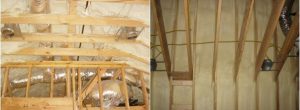
Smooth applications ensure customer satisfaction
- Keep the jobsite and the foam rig clean and neat. Customers tend to perceive clean jobsites and equipment with a good quality application and conversely a messy job site tends to be associated with poor quality.
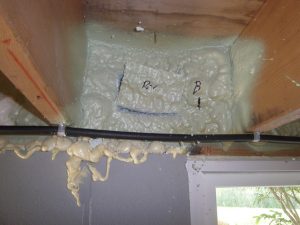
Running some tape and plastic would have made this job much neater.
- Protect items in the spray area from overspray. Many contractors don’t mask off items in attics and crawlspaces such as HVAC equipment, water heaters, ductwork, flooring, etc. Mask off everything in the area that overspray can get on. A great way to emphasize this to your customer is to note it in your bid as a separate line item.
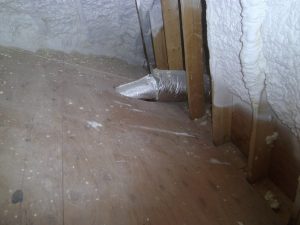
Clients don’t like seeing overspray on areas that are not supposed to be foamed.
- Develop effective quality control and inspection procedures. Keep good job records, take quality control samples during application. Have a final quality assurance inspection by your own folks before the final walk thru with your customer.
Work in Different Markets
Sometimes a specific marketplace is so crowded that there just isn’t enough work to go around and even companies performing good work start bidding low. In those cases, you need to broaden your business scope.
Find industries the low-bid applicator doesn’t work in. For example, if the low-bid player is in residential insulation markets, then find other markets in your area that use or could use foam. Here are some examples
- Cold storage
- Produce storage (citrus, vegetables, fruit)
- Meat packing plants,
- Supermarket warehouse
- Agricultural buildings, poultry sheds, alligator farms, mushroom farms, etc.
- Fiberglass fabrication
- Boats, hot tubs, spas, tanks, pipes
- Fishing Industry
- Fishing, crab and shrimp boats, processing facilities, warehouses, offshore storage, and processing plants
- Metal fabrication
- Tanks, pipes, vessels, etc.
Most of these industries negotiate prices with a limited number of contractors who know how to perform the work properly. So, you typically can charge a little more.
In conclusion think of extras that your company can offer your client such as blower door measurements before and after the application to demonstrate the amount of air sealing the foam provides. The more you separate your services from competitors the more you can charge for the job.
Author: Mason Knowles
About Mason Knowles:
Mason Knowles is the President of Mason Knowles Consulting LLC, a consulting company specializing in providing technical information, education, and training for the SPF industry.
Knowles has more than 48 years of experience in the spray polyurethane industry as a consultant, contractor, material supplier/manufacturer, equipment manufacturer and trade association professional.
Knowles is a member of Spray Polyurethane Foam Alliance (SPFA), Insulation Contractors Association of America (ICAA) and contributes frequent web-based presentations on SPF issues. He is a SPFA Certified Field Examiner, Chair of SPFA Consultant’s Committee, accredited building envelope and roofing inspector and instructor. Knowles chaired the ASTM committees on SPF roofing (D08.06) and standard specification for closed cell SPF (C-1029) for 20 years. He regularly writes articles for national trade journals, provides presentations for trade groups and other organizations on the SPF industry.
Website:
Masonknowles.com